Christmas Trees – December Trees of the Month

christmastreeby Ann Farnham, LLA

Among the pleasures we enjoy in December is choosing a Christmas tree. The choices are many: the firs (Douglas Fir, Fraser Fir, Balsam Fir), pines (Scotch, Eastern White), red cedars, and spruce (Colorado Blue, Norway, Concolor). Throughout the United States there are more than 35 different evergreen species grown for the holidays. They are available either cut, in containers, or balled and burlapped.

If you choose to purchase a cut tree, try to prevent the cut section of the trunk from being exposed to the air for more than three to six hours; it should be put into a container with water as soon as possible. Next, trim off the lowest branches which might interfere with the tree’s staying upright in a stand, and then remove ragged branch tips or unattractive branches. Saw off an inch of the trunk so the tree can absorb water freely, and fasten it to its stand, which should contain plenty of water. The water, especially at first, should be replenished often.

Artificial Christmas trees are often made of PVC, a dangerous chemical, which is not biodegradable, and does not have the wonderful fragrance of a real tree. However, they may be used for many years and are maintenance free.

A live tree, while somewhat more labor intensive to care for, may be planted in your yard after its holiday use, and enjoyed for years to come. You must do some planning before you take the tree home but it is well worth while. 1) Determine what spot on your property affords the correct exposure (full sun) and space. Check a good source or the internet to determine how much space your particular species of tree will require when mature. 2) Dig the hole NOW before the ground freezes. Digging a frozen hole is no fun. Make the hole approximately 2 times the width of what you expect the container or root ball will be. This is important; and do not dig the hole any deeper than the height of the container or root ball. Fill the hole with leaves or mulch as insulation, and cover the hole and the pile of soil with a tarp and more leaves or mulch to avoid freezing. Throw away whatever sod was dug up as you do not want it included in the backfill.

Your live tree should be indoors as briefly as possible; place it at first (in a waterproof tub or container) in a garage or porch to allow it to acclimate to warmer temperatures. Water it lightly and frequently, or place ice cubes over the root ball to keep the moisture levels up. Spraying the tree with an antidessicant such as Wiltproof will help control moisture loss through the needles.

When the tree is ready for planting, roll it into the hole and orient it so that its best side faces your house or the street. If the hole is too deep, add soil into the bottom and compact it until it is the right depth. Remove as much of the burlap around the root ball as possible; if it is in a container, remove the container. If it is in a wire basket, cut off as much of the basket as you can. Then, begin to backfill with the soil you set aside. Water it thoroughly and slowly as you fill the hole; this will push out air pockets and saturate the sides of the hole as well as the back fill.

It is not necessary to stake or guy the tree. Cover the area – to the drip-line- with 2-3” of double-shredded, hardwood bark mulch, keeping the mulch 2” away from the trunk. Water your Christmas tree every day for a week, twice the second week, and then once a week until the ground freezes and your hose becomes useless.

BEST WISHES FOR THE HOLIDAYS FROM YOUR EWING ENVIRONMENTAL COMMISSION!
Ash Trees – the November 2015 Tree of the Month

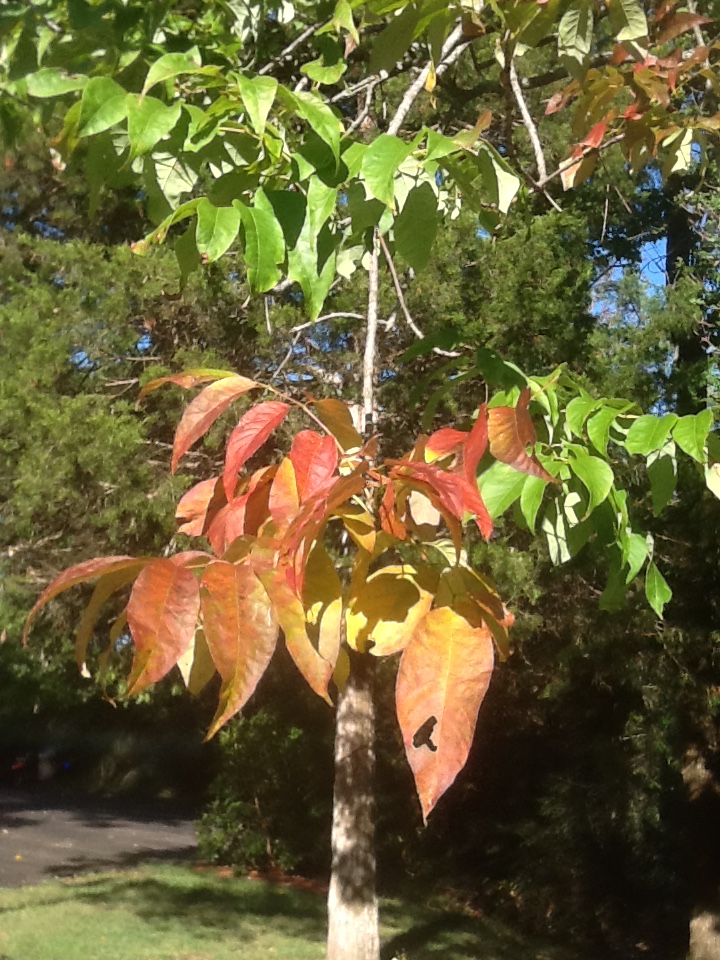
ash_treeby Ann Farnham

Ash trees are ubiquitous in our town because they can grow almost anywhere; they may have been over-planted because of this robustness. They populate our yards, streets, golf courses, parks and woodlands. Exceptional as shade trees, they tolerate all kinds of conditions, and have beautiful fall foliage. These medium–to-fast growing trees range from Nova Scotia and Manitoba in the north and to North Florida and Texas in the south.

There are many species of Ash; our most common are White Ash (Fraxinus americana), and Green Ash (Fraxinus pennsylvanica). These two species are challenging to differentiate but suffer the same problems shared with all the Ashes: many fungal diseases and insect predation. Importantly, the recently introduced Emerald Ash Borer is emerging as the most serious pest afflicting Ash trees today. The White Ash in its native habitat is primarily a forest tree while Green Ash is mainly a riparian species.

Both species have compound leaves (usually 5 to 7 leaflets per leaf) which measure 8-15” long, arranged opposite each other on a stem. They are dark green in summer and the fall foliage ranges from bright yellow to maroon and deep purple. The bark is grey to grey-brown and mature trees have a furrowed, narrowly ridged diamond shaped texture. The flowers, which appear before the leaves in spring, are inconspicuous. The fruit, known as samaras, are profuse, flat, and measure 1” to 2” long.

Ash wood is dense and white. It is used for baseball bats, furniture, tool handles, and flooring, among other things which require strength and resilience.

emerald_ash_borer

Debbie Miller, USDA Forest Service, Bugwood.org

This fine and useful tree, however, seems doomed. The invasive Emerald Ash Borer (EAB) is killing ash trees throughout the North America in huge numbers. Many municipalities are taking down trees preventatively and at this time many thousands of these trees have been preemptively cut down or died from the EAB, which seems impossible to eliminate. The EAB was first introduced in Michigan from Asia in 2002 and has now migrated to the east coast. It has been spreading in Pennsylvania for the last few years and last year was found in New Jersey.

Green_ash_killed_by_Emerald_Ash_BorerA recent survey, conducted by Rutgers’ Urban Forestry Program found more than 840 Ash trees growing on Ewing public land within 10’ from sidewalks and trails alone. It is predicted that the Ash tree loss in Ewing will be enormous.

For more information and details about this pest, please check out our Emerald Ash Borer page.

The Ewing Environmental Commission welcomes suggestions for Trees and other Topics from all Ewing residents. To email suggestions or questions email us at eec@ewingnj.org.

To calculate the value that trees add to your property, go to treebenefits.com/calculator.

Sourwood – August Tree of the Month

Oxydendrum arboreum. leaves and flowers, 7/15

Oxydendrum arboreum. leaves and flowers, 7/15

by Ann Farnham, LLA

The tree favored this month by the Ewing Environmental Commission is Sourwood, Oxydendrum arboreum, one of America’s most beautiful native trees. It is at home in the eastern and southeastern United States in USDA Hardiness Zones 5-9.  Ewing is located in USDA Zone 6b.

This specimen is located at a residence in the Mountain View neighborhood of Ewing.   Sorrel Tree and Lily of the Valley Tree are two other names by which it is known.

Sourwood, a pyramidal, medium-sized deciduous tree (usually 25 to 30’ in height) with slightly drooping branches has glossy green leaves which turn brilliant scarlet in the fall.
Its bell-shaped, fragrant flowers appear in June through July in this area and are white pendulous clusters which persist for several weeks. Honeybees favor the flowers, from which they make a fine flavored honey.

Sourwood is unusual in that it gives us summer flowering as well as extraordinary fall color.

This fine tree prefers an acid, moist and well-drained soil. It will thrive in full sun or partial shade, although the fall color is best when the tree is located in full sun.
Sourwood attracts few insects or diseases, none of which is serious.

The Ewing Environmental Commission welcomes suggestions for the Tree of the Month from all Ewing residents. Email suggestions or questions to lafarnham@verizon.net.

To calculate the value that trees add to your property, go to treebenefits.com/calculator/

Tree Lilac – July Tree of the Month

by Ann Farnham

treelilacThe beautiful tree (or large shrub) chosen by the Ewing Township Environmental Commission this month is a native of Eastern Asia and was introduced to the United States in 1876. It is hardy to USDA zones 4-7A (Ewing is zone 6b) and now has a range from the northeastern United States to eastern Washington, Oregon, and California south to northern Texas.

Among the trees which bloom in June and July, the Tree Lilac, Syringa reticulata) becomes covered in heavily scented, showy, creamy white flowers in 6-10” panicles which last about two weeks. The leaves are dark green, but develop no fall color. They are arranged opposite on the stems, have an oval shape, and a smooth edge. The bark is reddish-brown. This tree/shrub is available as a single-trunked or multi-trunked plant.

These trees can reach 20-30’ in height, and 15-25’ in spread. The branches are stiff and spreading and become arching with time. The habit is upright.

This is said to be the most trouble-free lilac; it has a few minor diseases or insects to worry about, but the pest list is not short. It is, however, resistant to mildew, scale and borers. A favorable site and good maintenance usually keep trouble under control.

The Tree Lilac prefers loose, well-drained, slightly acid soil, and full sun. Good air circulation and cool summers are helpful, but it is said to be fairly tolerant of air pollution and other adverse conditions. The tree can be “rejuvenated” by being cut to the ground and allowed to start over.

This is a fine specimen tree in the garden, and it is very effective in groups or near buildings. Its relatively small size and medium growth rate have also made it a useful street tree under overhead wires.

Flowering Dogwood – June Tree of the Month

cornusflorida

by Ann Farnham, LLA

Ewing Township’s Environmental Commission recognizes the beautiful Flowering Dogwood, Cornus Florida, as the Tree of the Month.

This lovely tree, a native to the eastern and central United States, is hardy from USDA zones 5-9 (Ewing is zone 6b), from Massachusetts to Florida and west to Texas.

Among the first trees to bloom in April or May, the Flowering Dogwood becomes covered in greenish-white, bloom-like bracts, four in number, which are usually 3-4” wide. The bloom period lasts up to two weeks and is followed by clusters of red, berry-like, drupes which turn scarlet in September. Birds love them.

These trees reach 20-30 feet in height, are beautiful in flower and have outstanding summer and fall foliage. This species produces brilliant white flowers, but there are varieties ranging from pale pink to warm red.

Flowering Dogwoods do best in acid, well-drained soil, and partial shade, although they will tolerate full sun with appropriate care. They are, unfortunately, subject to insect and disease problems. In the Northeast the most widely recognized scourge is a fungus, Anthracnose, which is difficult to control and slowly kills the tree. Fungicides may be effective.

Dr. Elwin Orton of Rutgers University has developed hybrids of Cornus Florida and Cornus kousa (Japanese dogwood), which are disease resistant and now commercially available.

Some straight species of Flowering Dogwoods which have shown resistance to Anthracnose have been selected and bred and are also now available at nurseries and garden centers.

The Ewing Environmental Commission (eec@ewingnj.org) welcomes suggestions for the Tree of the Month from all Ewing residents.

Saucer Magnolia – May 2015 Tree of the Month

by Ann Farnham, LLA

Magnolia_soulangiana

The beautiful Saucer Magnolia, Magnolia soulangiana, blooms in Ewing in April and May.

This small tree or multistemmed large shrub is a hybrid and usually thrives in USDA Hardiness zones 4 – 9 (Ewing is USDA Hardiness Zone 6b). It is a cross between Magnolia denudata and Magnolia liliflora, reportedly a hybrid made by one of Napoleon’s retired cavalry officers, Étienne Soulange-Bodin, around 1820 in France.

In the garden it makes a beautiful focal point and is one of the first trees to bloom in the spring along with flowering cherries, redbuds, and the shrub, forsythia.

Saucer Magnolia blooms before its leaves appear in the spring but the flower buds are frequently damaged by frost as they open so early. Having a medium growth rate, a tree may reach a height of 20 to 30’ with a variable spread, pyramidal to rounded in form with low branches; it is also grown as a multi-stemmed shrub. There are dozens of varieties, each with a distinctive size and shape, with flowers which measure up to 4 to 8” across, and colors varying from purple-pink to white.

The best site for a Saucer Magnolia will have an acid, moist, porous and deep soil and full sun to partial shade. It tolerates wind and urban pollution fairly well. The roots need ample room to develop and the tree should be mulched to the drip-line (keep the mulch at least 6” from the trunk). If pruning is necessary, it should be done right after flowering.

There are several pests and diseases which attack Saucer Magnolia but fortunately they are infrequent. The Yellow-Bellied Sapsucker woodpeckers seem to favor its bark, and ring the tree with little holes, but the damage is slight.

The Ewing Environmental Commission (eec@ewingnj.org) welcomes suggestions for the Tree of the Month from all Ewing residents.

To calculate the economic and ecological benefits of the trees on your property go to treebenefits.com. 

April Tree of the Month – White Fringe Tree

by Ann Farnham, LLA

whitefringetree

Photo by T. Davis Sydnor, The Ohio State University, Bugwood.org

The White Fringe Tree (Chionanthus virginicus) is a beautiful, deciduous tree sometimes known as Granny Gray-Beard or Old Man’s Beard. It is an enchanting sight in the Spring landscape.

Fringe Tree is dioecious, meaning that a tree is either male or female (it is not possible to know which until it first blooms, which is at 4 to 5 years old). The male tree has longer flower petals and thus is a little more eye catching. The flowers are pure white, lightly fragrant, in groups of four thin, drooping petals about ½ inch long, and they appear shortly before the leaves fully expand. The flowers, born  on fleecy, cottony panicles 6 to 8“  long, appear in the spring. They grow on the previous year’s growth, so if the tree is pruned, one must be aware of that fact. The female tree bears dark blue, fleshy, egg-shaped berries about 1/3 the size of an olive in August and September; birds, which can strip the entire tree of berries overnight, relish the fruit.

This tree is a native species and ranges from Maine to Minnesota, to Florida and Texas. It is native in southern New Jersey and is hardy in USDA Hardiness Zones 3-9. Ewing is USDA Zone 6B. The growth rate is slow, averaging 8 to 16 inches a year, but the plant will attain a height of 25-30 feet  in the wild (where they can be found along stream beds and marshy areas) and 12-20 feet in the designed  landscape. The habit is open and spreading.

The leaves are opposite on the stem, 3-8 inches long and half as wide. They are medium to dark green, shiny and smooth-edged. In the fall the leaves become yellowish-green to golden yellow. The bark is grey and smooth on young branches but becomes slightly ridged as the tree matures. The branches, after about 15 years, take on a more irregular shape and the large limbs arch down sometimes to reach the ground.

A Fringe Tree should be transplanted balled and burlapped or from a container. They like deep, moist, acid, and fertile soil and need full sun.

There are few serious pests and diseases which affect the Fringe Tree. There is occasional scale, borers and leaf spots, but it is reported to be tolerant of air pollution. It rarely needs to be pruned.

In the landscape Fringe Trees make beautiful specimens in groups or alone as a focal point. The British consider Chionanthus virginicus to be one of the finest introductions ever made to Great Britain from North America.


March 2015 Tree of the Month – Eastern Redbud

by Ann Farnham, LLA

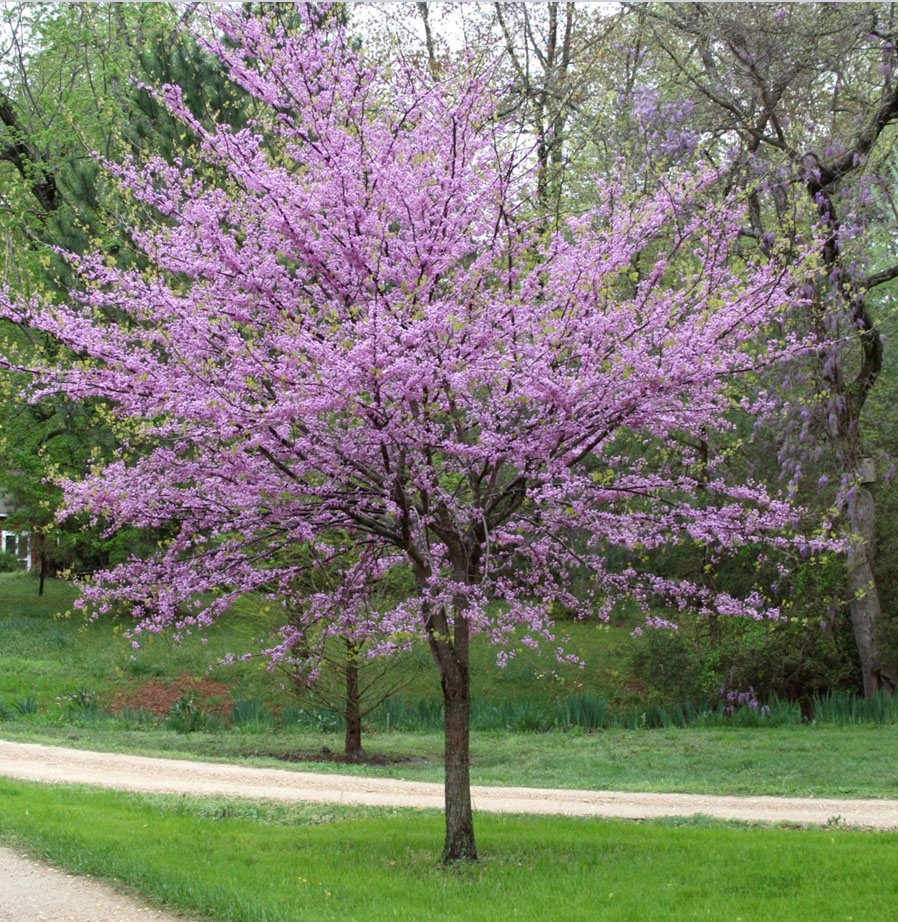
easternredbud

The Eastern Redbud, cercis canadensis, is among the first trees to bloom here. Blooming occurs in March-April when the buds turn into pink, white, or pink-purple legume-shaped flowers in clusters, depending on the variety, for up to three weeks. This tree is a breath of fresh air after a long and cold winter. The flowers are followed by bean-like seed pods several inches long, which drop from the tree when fully developed.

Redbud, a native deciduous tree, is found in USDA Hardiness Zones 4-9, from New England and the middle Atlantic states, south to Georgia, and to Illinois and Wisconsin in the Middle West.  Ewing is in zone 6b.
The Redbud leaf, from three to five inches long, is heart-shaped and alternately arranged on a zig-zag branching habit, and is reddish-purple when new.  By summer the leaves turn shiny green, but gradually change to yellow in the fall. One variety, ‘Forest Pansy’, has purple leaves. There are, among more than 20 varieties of Eastern Redbud, some with variegated, green and white leaves.

The Eastern Redbud typically ranges from a mature height of 8’ to 20’, depending on the variety, with a spread of 6’-35’.  Some varieties have a weeping habit and this usually small-sized tree normally has multiple trunks. A specimen in Morris County has been documented as having a trunk 8’-2” in diameter, a true “Champion” Tree. Redbud does well in most soils, but not in very wet, poorly drained soil.  It likes full sun or light shade. This tree, used as an ornamental specimen, is best planted young as it does not transplant well.

Diseases do not seem to be a great problem for this beautiful tree, although Canker and Verticillium Wilt do occur. Some caterpillars enjoy the leaves as do Japanese beetles, borers and web-worms. Regular watering, pruning out dead branches, and fertilization help keep Eastern Redbud healthy.

Another name frequently used for Eastern Redbud is “Spicewood Tree”, because in the southeastern mountains of Appalachia the twigs were once used as seasoning for wild game such as venison.

In the past, the bark of the Redbud was used as an astringent in the treatment of dysentery. The flowers can be eaten in salads, or fried. Cardinals, rose-breasted grosbeaks and pheasants, deer and squirrels enjoy the seeds.

February Tree of the Month — Witchhazel

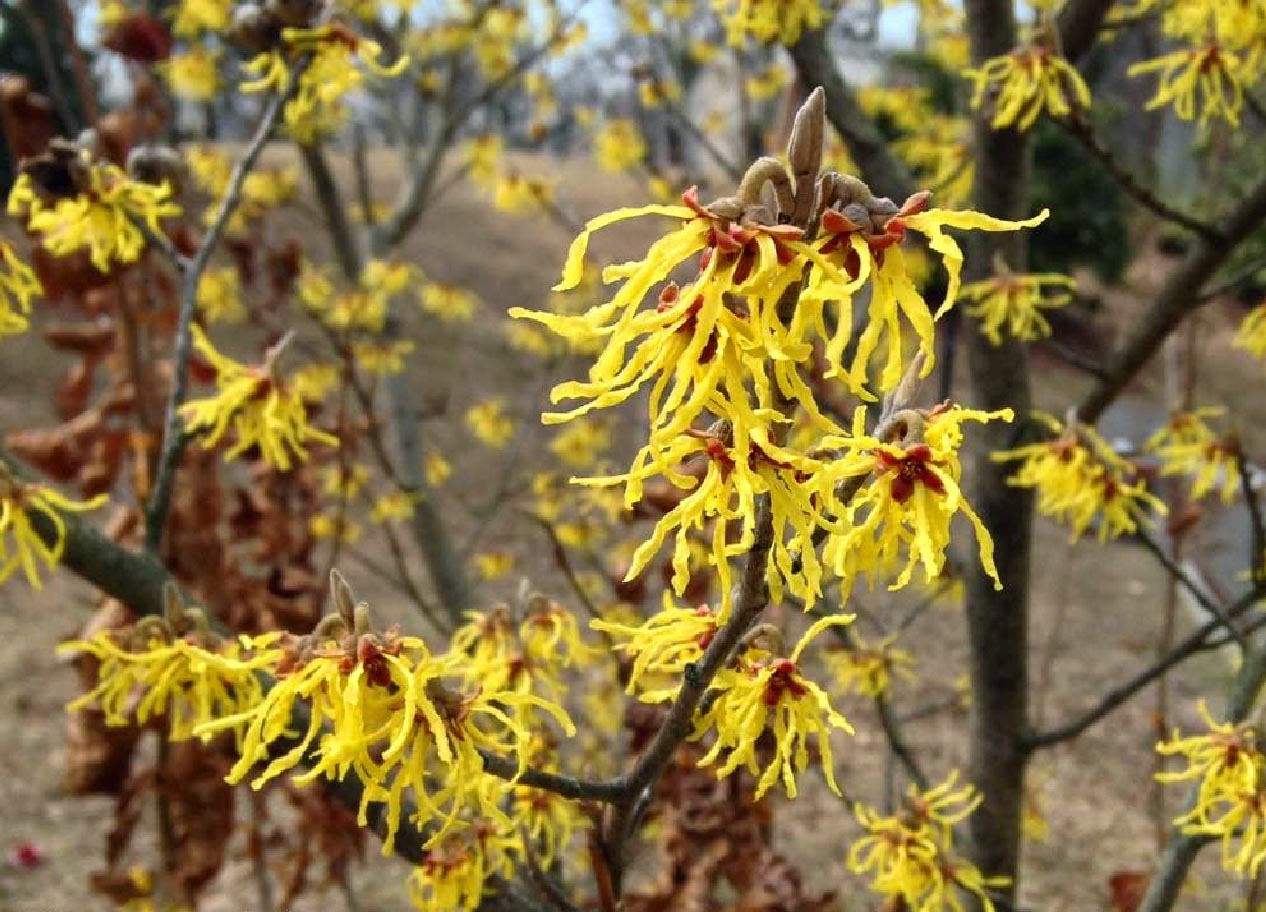
witchhazel

Hamamelis x intermedia  USDA Zones 5-9

The Ewing Environmental Commission has chosen the Witchhazel hybrid, Hamamelis x intermedia to be the February Tree of the Month. Although this small tree – or large shrub – is not a native (the crossing of Japanese Witchhazel, H. japonica, and Chinese Witchhazel, H. mollis), these two species combined produce a beautiful, fragrantly blooming plant that is outstanding in our winter landscape from late January through mid-March, depending on the weather and location.

Hamamelis x Intermedia can easily be mis-identified as a Forsythia from a distance. The flowers can be clear yellow but depending on the variety, are sometimes orange or reddish, and appear before the leaves. The flowers, 1.5” in diameter, have four ribbon-like, contorted and showy petals which are frost-proof. The fruit, which is a small, dried ½” hairy capsule, matures in the fall and opens to explosively discharge its two seeds a considerable distance. Turkeys, pheasants, cardinals and grouse enjoy Witchhazel seeds.

The bright green leaves are broadly oval and waxy, alternately arranged on zig-zag stems; they usually measure 3-4” long and the edges are toothed. The fall color is outstanding, with orange to red to copper hues. The bark is smooth grey to grayish brown

Hamamelis x intermedia will grow to 15’ to 20’ in height and will be equally broad; it is upright- spreading and will develop an irregular, rounded crown. It can thrive in either full sun or partial shade and is tolerant of poor soils although a well-drained, moist and fertile soil will allow it to thrive. Witchhazel is considered to be a maintenance-free plant, although occasional pruning may help to tidy it up. It is relatively slow-growing.

This small tree is useful in naturalized situations, near large buildings and in shrub borders. It is well suited for Ewing, USDA Hardiness Zone 6 B.

There are many cultivated varieties (CVs) of this plant available, not all of them yellow-flowering, as its characteristics have made it very popular. Most frequently seen varieties are “Arnold Promise’, ‘Jelena’ and ‘Pallida’.

Witchhazel oil extract is used medicinally as an astringent and for soothing sprains and bruises. The flexible wood was once popular for making divining rods, which were employed to detect water sources; the term “witch” is derived from the old English “wice” which meant bendable.

There are very few significant pests or diseases which affect this plant but Japanese beetles are known to enjoy the foliage. Deer do not favor Witchhazel.

Ann Farnham, LLA

Email the Ewing Environmental Commission with your suggestions for the Tree of the Month.