Ewing Project FeederWatch Report for Feb 20/21

By Joshlaymon (Own work)

By Joshlaymon (Own work)

by Lee Farnham

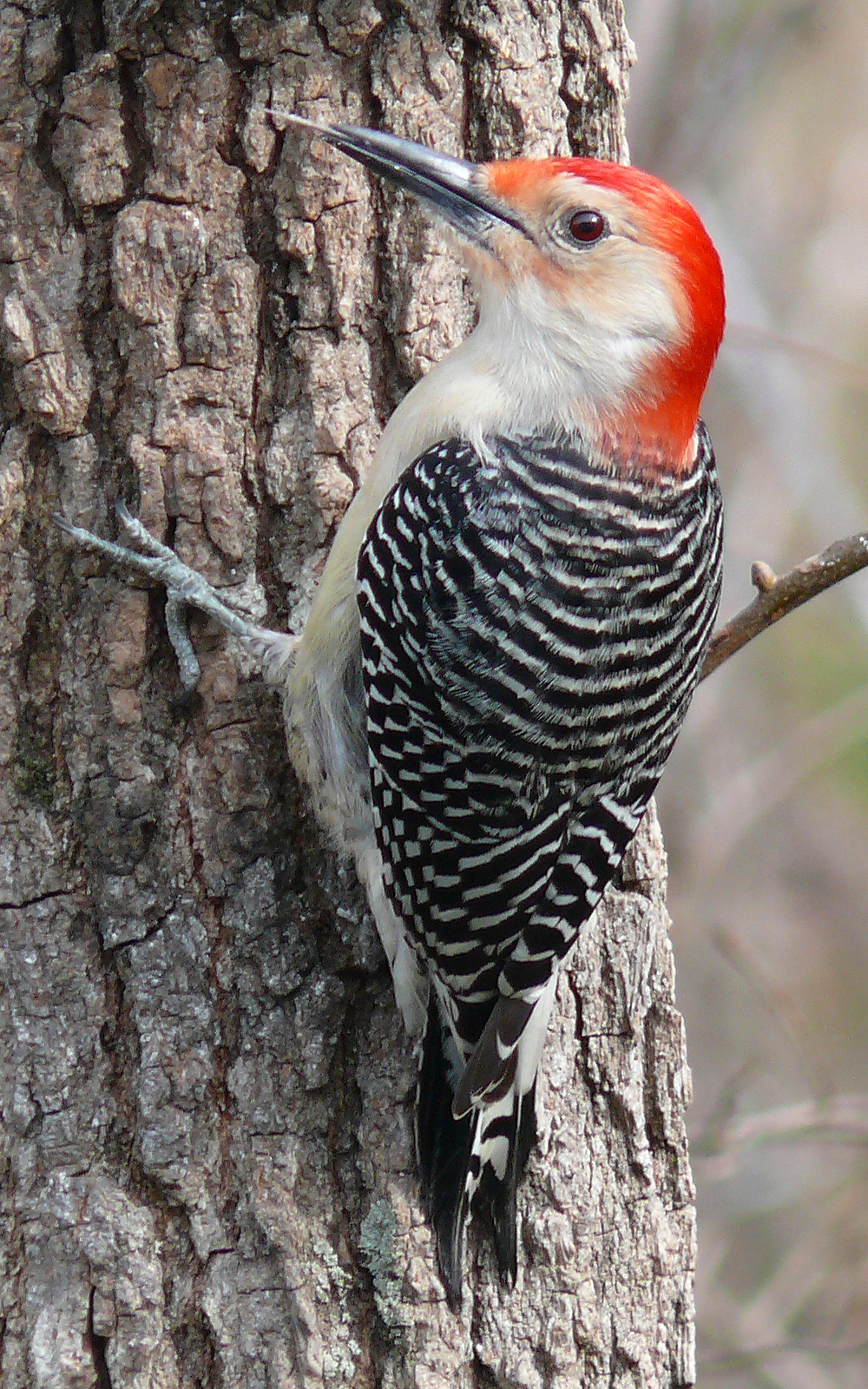
The numbers  of species seen, and the greatest number of  each while  I was watching this past weekend, were respectable for a mid-winter weekend.  Woodpeckers, Carolina Chickadees, Juncos, House Finches, Titmice, a Carolina Wren, Mourning  Doves, and White-Breasted Nuthatch were reliable  visitors,  but the highlights of the weekend were three.

  1. For the first time in a month, The Brown Creeper was back, scurrying up the Dogwood and the Sassafras looking for insects.  Have you ever noticed  how  the Brown Creeper only goes UP tree trunks, unlike  the White-Breasted Nuthatch, which goes up and down?
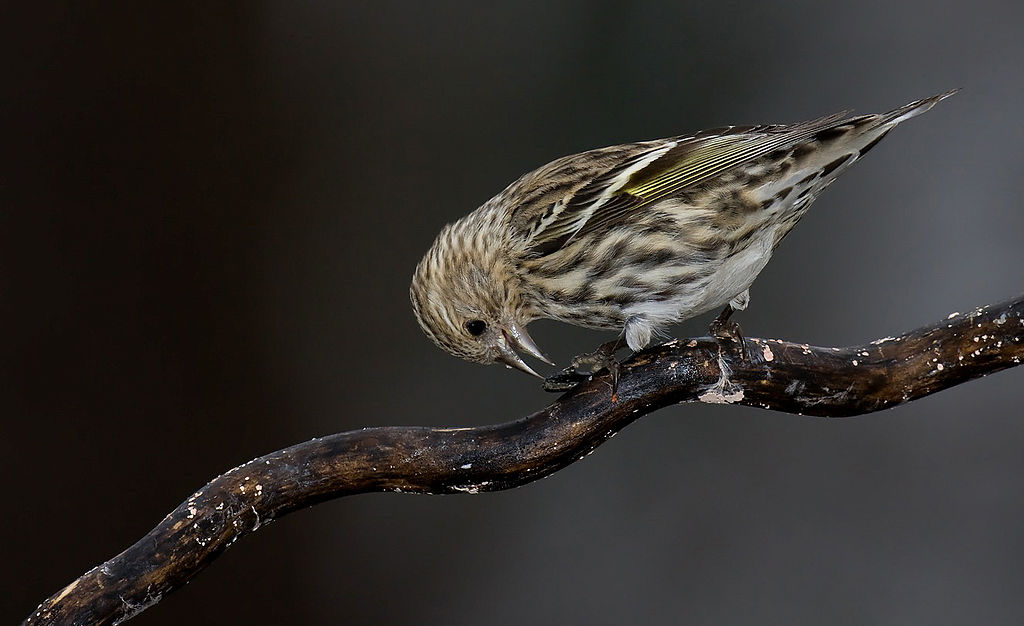
  2. We keep very close watch on Goldfinches because Pine Siskins sometimes are found amongst them, and we saw TWO on Valentine’s  Day (what better gift?)!  Since Pine Siskins can travel in large flocks (irruptions), we’ll need to watch closely over the next weekends to see if more show up.  (In 2007, when we  first saw them, there were a few, then a few more, then a bunch and then a swarm, and  we counted 55 at the high point….  and  then they were gone.)
  3. I took a break from my normal observation point and was in the back of the house when I looked out at the backyard and saw a Pileated Woodpecker (!!!) on our Sasssafras…  I scooted back to get my  glasses for a  closer look, but it was in vain as he had  left….still, it’s a hopeful sign because we had seen two of them on our Dogwood tree near the suet in March last year.

(For Lee’s project start to date results, check here.)

Cross Town Report

Feeder Watch has more than one observation post in Ewing, and we’re delighted to have made contact with a watcher in the Brae Burn neighborhood, who is also a member of the Washington Crossing Audubon Society.  When you compare what we’re seeing in Mountain View, to what’s seen in Brae Burn, there are some birds in common:  Mourning Doves, Downy Woodpecker, a Junco, Chickadee, a White-Throated Sparrow and House Finches. But they also reported 45 Common Grackles, 25 European Starlings and seven House Sparrows, most of which were seen on Saturday.  Those are birds that have been seen, but not with any consistency, in Mountain View.  While we may see Starlings and Grackles two or three times a season, House Sparrows have only been seen once or twice in eleven years.

(Note from the Editor – Lee continues to faithfully make his reports of bird activity in the northwestern section of Ewing for Project FeederWatch, a citizen scientist to ornithological research. He has been sharing the highlight of his results with readers weekly. For more information about Project FeederWatch go to feederwatch.org.)

Kiss Your Ash Goodbye…

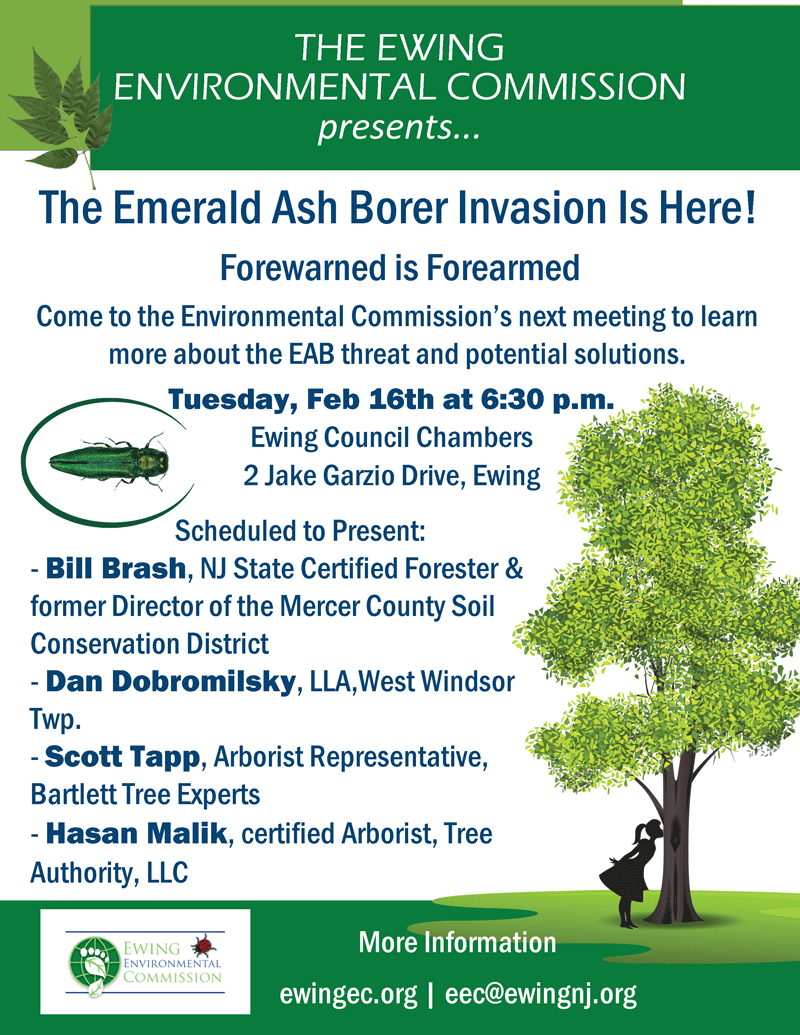
EABweb2

On February 16 at 6:30PM at Council Chambers in Ewing’s township offices, the Environmental Commission’s monthly meeting will be spent on learning more about the Emerald Ash Borer (EAB) threat to the health of our all our native ash trees.  This pest, first found in Michigan in 2002, reached New Jersey last year.  Without natural predators to destroy this pest, our entire ash population is at risk.

A Rutger’s Rapid Ash Survey of Ewing’s Ash trees on  public property last summer identified close to 900 Ash trees in parks, along roadsides and elsewhere and  concluded that the EAB was a real threat to Ewing’s tree canopy as Ash trees on public and private property were all going to be affected, and  soon.

To learn more about  the EAB threat, and possible remedies, the Environmental Commission has invited a number of people with specific  knowledge of the threat, and  how  it  might be addressed, to give informational presentations.

Presenters

  • Bill Brash, NJ Certified Forester (former Executive Director of the Mercer County Soil Conservation District) helped Plainsboro address the issue last summer..
  • Dan Dobromilsky, Licensed Landscape Architect of West Windsor Township, who was key to their addressing the issue last summer.
  • Scott Tapp, Bartlett Tree Experts, which has developed and applied plans to remediate against the threat in this area.
  • Hasan Malik, Tree Authority LLC, a nursery owner who has been instrumental in the selection of trees to replace stricken Ashes.

We look forward to welcoming you to this informational meeting about the EAB threat to Ewing Township.

Atlantic White Cedar – February 2016 Tree of the Month

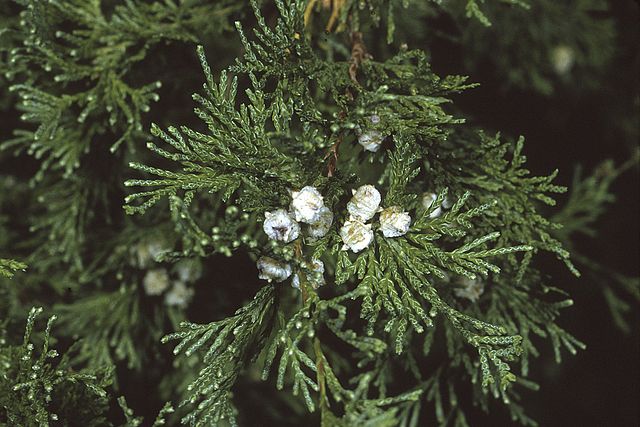
false_cypress_closeupby Ann Farnham, LLA

Atlantic White Cedar (Chamaecyparis thyoides) , also known as False Cypress, is not usually the handsomest specimen that we normally seek out for our gardens. Indeed, in its maturity almost ¾ of its trunk is bare of branches. It will reach 40 to 50’ high and 10-20’ in width. However, this native tree does have some good varieties which bear checking out. The tree is extremely useful.

A needled evergreen, Chamaecyparis thyoides requires very wet conditions: bogs, swamps, low spots, swales, and stream and lake sides. They are ubiquitous throughout the Eastern United States along a narrow band at the Atlantic coast from Maine to Florida, forming coastal buffers and stabilizing areas which might otherwise be bare. They require full sun and lower elevations as well as abundant water. Extensively used today in planting detention basins, bioretention swales, low spots in parks and gardens and other perpetually wet places, you will recognize them in many areas in Ewing.

These trees may be confused with Arborvitaes, but they do not share the same type habitat and the foliage and habit are quite different. False Cypress has scaly leaves in a flat, fern-like appearance, which are pointed at the tip. The paired leaves are bluish-green with white margins. The young tree shape is more columnar than Arborvitae. Like Arborvitaes, they are foraged by deer.

false_cypressThe False Cypress produces many spherical, ¼” diameter cones which at first are green to purple and then turn brown. They are prolific seed bearers, producing millions of winged and light-weight seeds per acre which are very easily wind-borne. The seeds can remain viable and dormant for years, so poor conditions at germination time do not affect them. The result is very dense forests of these trees. One of the best known and beautiful stands is the White Cedar Swamp in the Cape Cod National Seashore where one can walk on an interpretive trail through the area.

Acid soils of pH 5.5 or less allow these trees to thrive. They are shallow rooted, however, and will topple in high winds and heavy snow or ice loads so care must be taken in their site selection. They harbor very few insect or disease pests.

The reddish-brown wood is used for fence posts, ties and shingles, and boat construction as it is moisture and decay resistant.

The Ewing Environmental Commission welcomes suggestions for the Tree of the Month from all Ewing residents.

Helpful Tree Links

  • To calculate the economic and ecological benefits of the trees on your property go to treebenefits.com.
  • To estimate the age of a tree, go to mdc.mo.gov


Late January Snowmageddon Brings Birds Flocking to Local Feeders

Project FeederWatch Update for Jan 23 and 24

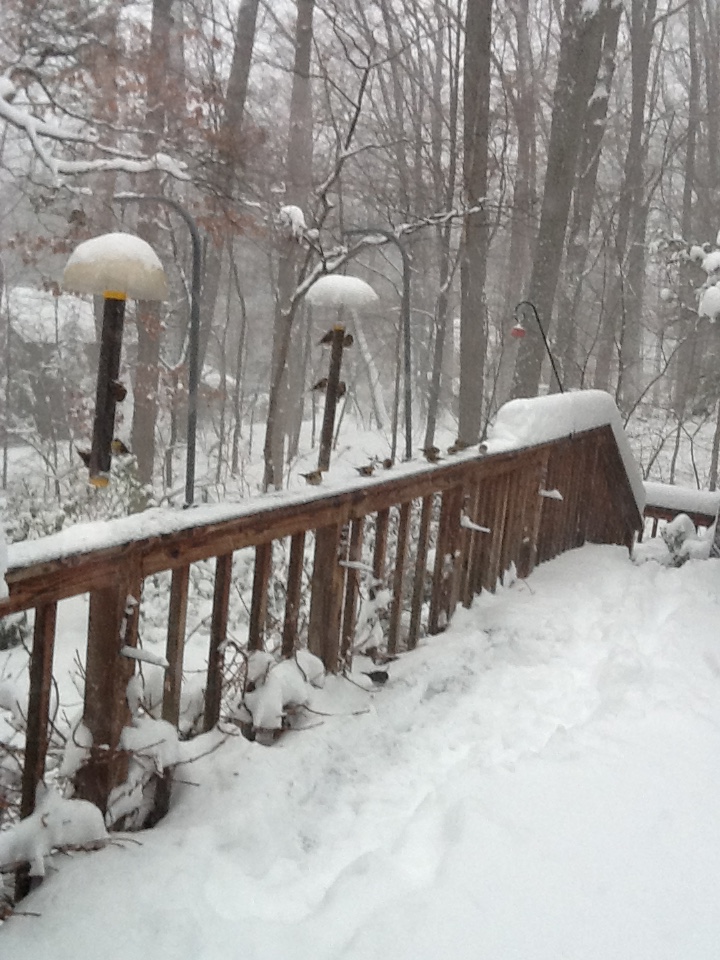
IMG_0804


by Lee Farnham

The forecast for last weekend was grim: snow starting late Friday night, and ending who knows when….  It started around 6PM Friday and didn’t end until late Saturday night. By the time it had stopped the accumulation at our house was really overwhelming, close to 18”.  The Township declared a state of emergency, so the plows didn’t come until close to 1PM on Sunday. How did this affect our weekly Feeder Watch?

Well, if you thought last week was a good number of birds, Saturday past, when it snowed all day long, turned into a real procession of Goldfinches, plus some unexpected visitors: six Common Grackles, and a solitary Crow!

Before counting on Saturday, we filled the two Thistle Feeders and spread thistle seed on the deck and deck rail. We also filled up the Squirrel Buster feeder with Sunflower hearts, and spread a lot of sunflower on the ground (Juncos, Titmice, White-throated  sparrows, Squirrels, Goldfinches and Mourning Doves were grateful for that).  The Safflower feeder was also filled (it’s about eight feet away from the Sunflower feeder, but separated by a large Blue Holly bush which offers great cover for birds. The next step was to change the suet in the suet feeder, so two new cakes were added while the leftovers were dumped on the ground for the squirrels and Juncos. The final step was to fill up the heated bird bath so water would be available…it’s really great to see Titmice, White-Breasted Nuthatches, Cardinals and other species all taking their turn at the bird bath.

Saturday’s Feeder Watch was unprecedented, it snowed all day, and we set a record for the number of one species (Goldfinch) seen at one time: 57!!  (It broke the Pine Siskin record of 55, from the winter of 2007-2008). We also saw 17 Juncos, 14 Mourning Doves and eleven House Finches, all records for 2015-2016 season.

Sunday was clear and a little warmer, and while there were still birds at the feeders, Saturday was when all the big numbers were seen….even though we’re still waiting for the Brown Creeper to come back

Project FeederWatch Update Jan 16 &17

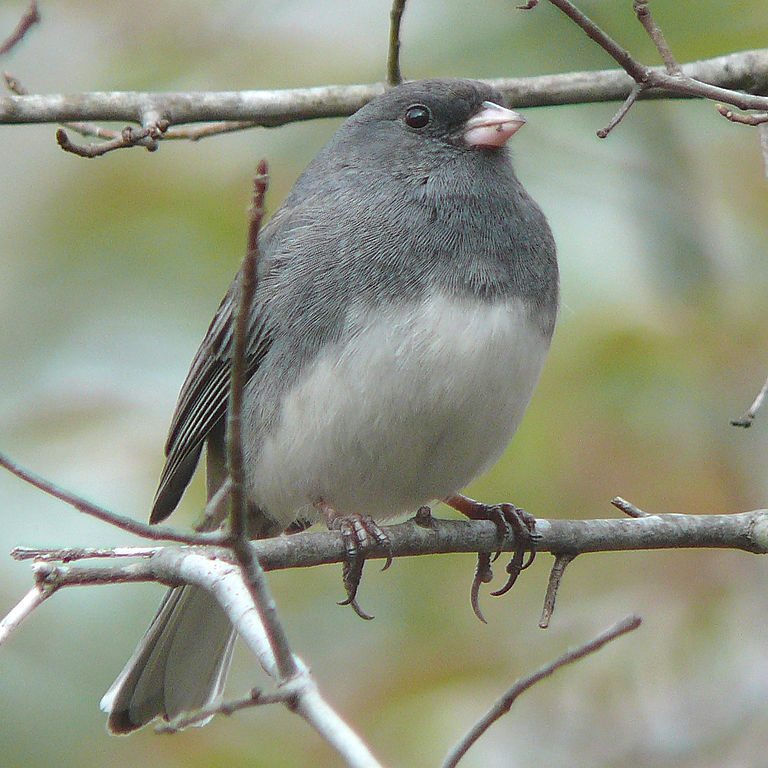
Dark eyed Junco

Dark eyed Junco

by Lee Farnham

A hint of things to come was the theme of this weekend’s FeederWatch as some larger numbers of birds were seen within some species this weekend.

Since FeederWatch, run by the Cornell Laboratory of Ornithology, asks that watchers record not only the species seen, but also the greatest number of that species seen at any one time, we’d been wondering why the numbers were down from years previous…but no more.

Overall fourteen species were recorded, but the total number of birds seen at any one time of those species increased to 85 in all, up from 47 the weekend before!

The big jump was on Sunday, as a result of two changes:

  1. It was snowing, and about 32° F. Whenever it snows, demand really grows.
  2. We decided to spread Thistle seed (Niger) along our deck rail  and on the floor of the deck underneath the rail too (to supplement the two Thistle feeders with 12 positions each).

You wouldn’t think that a small change like that would have such a big result, but it did.  The highest number of Juncos seen at any one time jumped to 12, but the really big gain was in Goldfinches, which peaked at 37 on Sunday afternoon.

At the same time there were Robins all over the place; we saw 15 in the feeding area on Sunday, and the number of House Finches was big, ending at eight!

Mourning Doves were scarce, just one, and there’s still no sign of the Brown Creeper (aka Creepie) who was a regular visitor for the last ten years.  Please tell Creepie that we’d love to see him if he’s in your yard. We miss him.

Project FeederWatch Update This Week

Eastern_GoldfinchBy Lee Farnham

This interesting weekend began when the temperature was above 50, but you wouldn’t have known it from the Goldfinch and Mourning Dove activity at our feeders. Starting Sunday morning, and continuing through that afternoon, the Goldfinches and the Mourning Doves, in particular, seemed to be queuing at or under the feeders without cease….which makes us think that their ability to sense bad weather coming is better than ours…. they were storing up for the cold and potential snow.

Our species count this week was 13, down several from what was the norm last year. We’ve seen The Brown Creeper only once this year whereas he was a regular visitor last year. Also, Blue Jays just aren’t going to the feeder area when we’re watching (although we know they’re at the front of our house because we can hear them).

And there’s the question of why we’re not seeing bigger numbers of birds (although the Goldfinches and Mourning Doves were good this weekend). But it’s not usual that we see only one White-Throated Sparrow, or two Juncos, or a couple of Carolina Chickadees. Their numbers are off (we saw 16 Juncos one weekend last year, and have seen up to eight White Throats and four Carolina Chickadees).

The weekend proved, once again, how important it is for you to provide water for the birds at your feeder. Without snow, when the Temperature drops like a stone, where do birds turn for water? At our house they know that there’s water on the deck, thanks to the Immersion heater in the bird bath. It’s really nice to be able to see Titmice, White-Breasted Nuthatches, Cardinals, Carolina Chickadees, Goldfinches, House Finches, Juncos and the Carolina Wren all taking their turns at the water when it’s freezing outside.

The coming week sounds more like winter, perhaps there’ll be some of our regular visitors returning. To now, we’ve reported only 20 species seen since the beginning of November. In the 11 years we’ve been watching and reporting to Feeder Watch, we seen 43 species.

Feeder Watch activity to date

January 2016 Tree of the Month – Eastern Red Cedar

Eastern_Red_Cedarby Ann Farnham, LLA

The Ewing Township Environmental Commission recognizes a stately eastern redcedar tree (Juniperus virginiana) in Village on the Green Park as the Ewing Township Tree of the Month for December 2011.  Village on the Green Park is along Sabrina Drive.

Eastern redcedar is an evergreen tree of many uses. The wonderfully aromatic wood repels moths and is used for chests and to line closets.   Native Americans made flutes from the wood.  Colonists made log cabins out of the wood.

A small redcedar trees makes an excellent chimney brush. In Virginia, my wife and I would tie ropes to both ends of a redcedar tree and then pull it up and down the chimney with me on the roof and her by the fireplace.

Eastern redcedars are used as Christmas trees, most often in the South.

The fruit of eastern redcedar are small pale blue berries with a strong flavor that can be used as a spice and when chewed are reputed to heal canker sores.

Wildlife benefits provided by eastern redcedar include shelter (it is very cozy nestled within the branches of a redcedar) and food. Many birds eat the berries, the seeds of which pass unharmed through their digestive tract.  Thus redcedars use birds as effective dissemination agents.  Redcedars are among the first trees colonizing abandoned farm land.

Check out the Tree of the Month in Village on the Green Park.  This underutilized, open park is ideal for activities such as dog walking, kite flying and Frisbee™.

The purpose of the Ewing Township Tree of the Month is to call attention to Ewing Township trees of note based on their beauty, size or historical significance and thus engender a greater appreciation by residents for the fine trees in our community.

Let the Ewing Township Environmental Commission know about your favorite trees in Ewing Township and perhaps one will be selected for Ewing Township Tree of the Month.

Project Feeder Watch Update

Eastern_Goldfinch

by Lee Farnham

(EEC Chair Lee Farnham is a long term participant in Project FeederWatch, a citizen-science project that changes the way observers see birds.  Participants observe birds in their own backyards, helping scientists at the Cornell Lab of Ornithology track what’s happening with feeder birds across the continent (US and Canada).  More than 15,000 FeederWatchers come from all walks of life, including people of all ages and levels of bird-watching skill. Here is his report for Dec 26th and 27th.)

This weekend was different from the last two, although Saturday’s temperature was much higher than normal (Sunday’s was lower), but there were far more Goldfinches and House Finches than in the previous two weeks. Between them they accounted for only 13% of the species seen, but Feeder Watch also wants to know the greatest number you see at any one time, which is where the big difference was:  12 Goldfinches and 6 House Finches were the high numbers;  that was 42%+ of the total birds seen!

Supporting  species are usually the Carolina Chickadee and Tufted Titmouse, and their numbers were good.  Two white-breasted Nuthatches showed up, and there were four Juncos, a rise from weeks previous.  Although we have seen up to six different Woodpecker species when reporting for Feeder Watch, the regular visitors are the Red Bellied Woodpecker, Hairy and Downy Woodpeckers, all seen this week.  The other species (Pileated, Northern Flicker and Yellow-Bellied Sapsucker) aren’t around until later although The Pileated was heard.

Mourning Doves were in short supply; only one was seen this week again.  They’re not coming like they did last year even though the Safflower seed feeder they like to feed under is unchanged.  Maybe they’re put off by the green growth under the safflower feeder, the presumed result of feed germination during the much warmer weather.

Other regular visitors were the Northern Cardinal (2), Carolina Wren (1), White-Throated Sparrow (1, a low number) and Blue Jay.

The unexpected treat was a solitary House Sparrow, usually seen only two or three times a year!

FeederWatch Update

Red-bellied_Woodpeckerby Lee Farnham

(EEC Chair Lee Farnham is a long term participant in Project FeederWatch, a citizen-science project that changes the way observers see birds.  Participants observe birds in their own backyards, helping scientists at the Cornell Lab of Ornithology track what’s happening with feeder birds across the continent (US and Canada).  More than 15,000 FeederWatchers come from all walks of life, including people of all ages and levels of bird-watching skill. Here is his report for Dec 19th and 20th.)

The cold weather this weekend definitely helped the overall species count as my cat and I logged 15 species after watching early morning Saturday for about an hour, and mid-afternoon on Sunday until dusk.

Three species of woodpecker were seen:  Red Bellied, Hairy (2) and Downy (3).  They’re attracted to our suet, but also to our sunflower hearts.  Goldfinches come from the sunflower hearts and Thistle, as do Northern Juncos.  House Finches like sunflower hearts as do White-Breasted Nuthatches, and the White-Throated Sparrows, who come at dusk, like the Cardinal.

The safflower feeder is most popular with Titmice and Carolina Chickadees, also with House Finches.  A solitary Mourning Dove was seen beneath it, but they’ve been notable by their absence this year.  A solitary Black Capped Chickadee came by, a first for us, and was followed by a regular visitor, the Carolina Wren.

The Brown Creeper finally put in an appearance, his first this year during FW time….we were thrilled to see him.


If you enjoy observing the natural world around you and its wildlife participants and would like more information about Project FeederWatch, check out their website at feederwatch.org or email the EEC at ewingec@gmail.com.

An Irruption of Note

PineSiskin

By William H. Majoros (Own work) [CC BY-SA 3.0 (http://creativecommons.org/licenses/by-sa/3.0)%5D, via Wikimedia Commons

By Lee Farnham
2009-2010 Project FeederWatch season

It was in early December last year, while doing my regular weekend bird feeder survey, that the advance scouts showed up.  Three of them were at our two thistle feeders, usually hogged by the Goldfinches.  When I looked at them I saw Goldfinch characteristics, but heavily streaked like a House Finch; I made a mental note to look up hybridization among the two species in Sibley’s Bird Life and Behavior, and went back to recording and counting the other birds.

Every winter for the past four years we’ve been members of a Cornell Ornithology Lab project called Feeder Watch (feederwatch.org).  A nationwide and Canada effort, it involves 15,000 members watching their bird feeders for two consecutive days each week, and reporting what they see.  You note not just species, but the maximum number of that species you see at any one time.  At our feeders, for example, we always have White-Throated Sparrows poking around under the sunflower feeder for what’s spilled, but the number you see depends on the time of day you’re watching.  There may be one or two most times, but if you’re watching at dusk, and have binoculars that gather lots of light (like my 7x50s), you could see six or seven.  That’s why I try to watch in the mornings, afternoons and at dusk on Saturday and Sunday, probably about two hours a weekend.

On a normal winter weekend we’ll report from 13 -15 species, more if the hawks (Coopers and Sharp-Shinned) are around, fewer if the temperature’s high, 20+ if there’s a snow storm and their other food sources are restricted.

The weekend I saw the scouts I forgot to check the Sibley, so I didn’t report them, but there were more next weekend!  Five was the most I saw at any one time, but they were there continuously, and very hungry.  The Goldfinches weren’t around so these birds had little competition at those feeders.

Over the years Ann has landscaped our backyards with trees and shrubs attractive to birds, and we’ve put feeders close to them.  A large Blue Holly shrub is between the safflower feeder (columnar in a squirrel-proof cage), and the sunflower hear feeder (two-sided, counter-weighted access bars, suspended from a cable, and beneath a Plexiglas witch’s hat… challenging for squirrels).  The Holly gives great cover when hawks are around, as do the Canadian Hemlocks, close by.  Winterberry Hollies offer food for seldom seen Bluebirds, among others.  Suet (berry and nut, two cakes at a time) are suspended from a cable with a large platter above them to discourage squirrels (it does), but in high winds, like now, the platter becomes a sail and the whole contraption ends up five or ten yards away; it’s exciting to see it fly off.   Finally, the two thistle feeders are on curved poles off the deck rail, one of them is a large pan of water, year-round.  It’s got a thermostat in it now to keep the water from freezing, and it always draws a crowd.

When I finally read the Sibley’s Bird Life and Behavior the next weekend, starting with Goldfinches, what leapt out at me was the phrase: “Goldfinches do not hybridize!”  Yikes, I thought, what does that mean,,, and then it dawned on me: this is a different species!  So I quickly pulled down Sibley’s Guide to Birds, and Peterson’s Field Guide, and discovered that these were Pine Siskins, a species I hadn’t seen since the early 50s in New Mexico! Wow!! Pine Siskins in New Jersey, with their sharp little bills, and touches of yellow among their brownish streaks; they looked just like they should.  I included them in my census for that weekend, modified my report for the previous week to include them too, and made a special comment to Feeder Watch asking if their appearance was at all unusual.

It was, they replied, for it turned out that we were in the beginning stages of an irruption (moving in irregular winter patterns) of Pine Siskins last winter, and they were heading east from western Pennsylvania.  (Feeder Watch website has a neat feature that lets you select a species, your region and the year, and it gives you an animated map of ow that species has moved through our region during that time.  Different sized circles and colors represent reporting stations and numbers.  Watching that display you could see the Pine Siskins’ invasion build from the west.

The few advance scouts of this nomadic species, which travels in flocks and is usually confined to the western states every other winter, turned into a veritable flood over the next three months.  Each successive weekend we reported higher and higher counts of them seen at any one time. with the peak at 55!  It was akin to O’Hare or LaGuardia on a Friday evening: the feeders could hold 30 or so birds, so the rest stacked up in the Dogwoods, Cherry and Oaks, waiting their turns.  New arrivals were first to the Oaks, then Cherry, then Dogwoods, and onto the feeders as other left. You could almost see their traffic controls assigning locations.  As the number grew, so did our reporting site on Feeder Watch‘s animated map, until it was a big green circle!

The Feeder Watch staff, in a preliminary report through mid-February, 2009, compared Pine Siskin sightings from winter 2007-2008 to winter 2008-2009 at reporting locations, and found that sightings, country-wide, had risen from 24.8% to 50%!  The average flock size increased from 11.7 to 15.  The change was even more dramatic in the east, where comparable reports went from 18.6% of feeders reporting them to 49.6%, and flock size increased from 7.2 to 15.5. this past winter.

What caused this?  The Feeder Watch account of the Pine Siskin irruption 2008-2009 goes on to say: “Pine Siskins typically irrupt in the West every other winter, but the pattern is much less reliable in the east.  The large numbers of Siskins in the east this winter are most likely due to a shortage of their typical winter food supplies in the forests of Canada.”

It’s too early to tell if they’ll be back this year because the Feeder Watch season has only just started, but the food supply in Canada will be key.  The species total is about the same, but numbers seen are a bit down, perhaps because of the wet year.  Regular visitors include Titmice, House Finches and Goldfinches, Juncos, a White-Breasted Nuthatch, Carolina Wrens and White-Throated Sparrows.  The three Woodpecker species (Red-Bellied, Hairy and Downy) are covering the suet and an occasional Cooper’s Hawk cruises by looking for a fast lunch (and got a Mourning Dove the other day).  If the Pine Siskins do return, we’re ready for them, as we just got a new twenty pound sack of Thistle Seed, their favorite!